Realistic Konmari for Moms Who Want Real Solutions
Inside: What parts of the Konmari method are useful for moms? What can we just ignore? Here's a run-down of the Konmari method from a mom's realistic perspective.
Have you heard of the Konmari method? In the past few years, Marie Kondo's book, The Life Changing Magic of Tidying Up, has taken the world by storm.
Thousands of people who want to declutter their homes have used this book as a guide to help them get back on track, but many parents have criticized it for being unrealistic for families with young children.
While there are certain parts of the book that have great advice for anyone, it's true that there are some things that are a little bit unrealistic for moms.
New: Tidying Up with Marie Kondo
Marie Kondo's new TV show, Tidying Up with Marie Kondo, recently released on Netflix. It's full of great ideas – even for moms.
Go here to learn more about the show, and see the best takeaways from each episode.
.
The Life-Changing Magic of Tidying Up
In this post, I will share with you the things from The Life Changing Magic of Tidying Up that have helped me as a mom, and I'll tell you about the things I've chosen to ignore.
Realistic Ways the KonMari Method Can Help Moms
- Start with the end in mind. Marie Kondo recommends visualizing your destination before you start. Then after you've done your visualizing, ask yourself why you want to do it.
It's always good to start with a good, clear mission in mind. This is great advice for anything, including tidying up your home. - Does it make you happy? Marie Kondo also wants you to ask yourself “Does it spark joy?” for the things that have no real reason for being discarded. As you're decluttering, when you see something that you want to keep but you're not really sure why you want to keep it, ask yourself the question “Does it spark joy?” Is it something that makes you happy? If not, it's probably something that you can get rid of.
- What do you want to KEEP? Instead of focusing on what we need to get rid of, Marie Kondo recommends choosing what we want to keep instead. This is a different way of looking at decluttering because it really helps you to focus on the things that are working for you.
- Handle each item. As you're tidying up your home, Kondo also recommends handling each item. Pick it up, look at it, and do a good assessment of whether or not it's something that you want to keep.
- Declutter by category, not place. When you want to declutter your clothing, for example, she recommends putting it all in one place at the same time and decluttering from there, instead of going from closet to closet throughout your house.
- Begin with the easy stuff. Another recommendation is to begin with items that are easier to make decisions about. This will get you into the mode of decluttering, it'll give you some decluttering wins in the beginning. It will build your decluttering momentum, which will make you better able to declutter some of the sentimental things later on. Wondering what the easy stuff is? This book is full of easy decluttering ideas.
Konmari Advice Moms Should Ignore
- Declutter everything in a category at the same time. One thing that's really hard for moms to do is to pull everything out at once. This may be realistic if your children are out of the home, but if you've got littles running around, having a bunch of clothes on the floor at the same time is close to impossible. It will be hard to find a big block of time to work on it all at once, and there's a good chance that pile of clothes will be transformed into a fort by creative kiddos. While it is a good idea to declutter by category, not place, sometimes it just isn't realistic. Instead of decluttering all of your clothes at the same time, you may want to instead declutter an even smaller category of clothing. It'll be much easier to pull all your jeans out and work on them at once as opposed to all of your clothes.
- Talking to your stuff is not required. You do not have to tell your socks, “Thank you for their service.” Marie Kondo advocates thanking the items you're getting rid of for their service. If this is something that you enjoy doing, you can, but I just found it a little bit goofy. If you want to do it, you could make it a game, especially with your kids, and say, “Adios” to all the things that you are decluttering.
- Folding socks into squares. This is not really necessary. Kondo also says that socks don't do as well or have bad energy when they are folded up or twisted up in a weird way. She has a specific method for folding socks. I've tried this method and it has not worked for me. It looks really cute in the beginning but it just wasn't practical.
I'm back to folding my socks the way I used to, and they seem to be fine with it.I decided my socks would be happier if I let them be free. Kind of like in a mosh pit. You can read more about my super-easy way to handle socks here. - Believing that you will never have to declutter again. Kondo says that once you declutter using her method, you will never have to declutter again. This is hard to believe. When you have children, things are always coming in and out of your house, and it's difficult to keep up with it all. Go easy on yourself and realize that you are doing all that you can to keep your home tidy. If things get cluttered from time to time, take a step back, visualize your destination and how you want your home to look, and get to work.
While I do think there are a lot of strange things in the book, I think it can be inspirational. Kondo looks at decluttering in a whole different way and it gives people different ideas for how to tidy up their homes and get rid of sentimental items.
I recommend the book, but I don't recommend taking it too seriously. As a mom of young kids, if I tried to follow the exact advice in the book, I'd be setting myself up for failure. However, there is enough good information in the book to make it a worthwhile read.
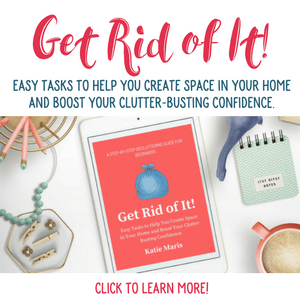
If you're looking for a decluttering guide that may be more appropriate for moms of small kids, Get Rid of It! A Step-By-Step Decluttering Guide for Beginners, might be a good choice. The book includes step-by-step instructions, realistic ideas, and inspiration to help you stay on track as you declutter your home.
New to this community? Start here, friend!

I am almost finished the book. My daughter read it before I had a chance to and we actually spoke about pairing the socks the way we usually have done in the past. I like the book and will use what sparks joy in her methods.
I loved the book! I’ve finished clothing (mine only), books, and papers so far. I totally agree with you about the socks! One of my biggest take aways has been confidence in letting things go that don’t give me joy. I feel like I finally got the permission I needed to get rid of things I given to me by others, especially my parents. It sounded so silly initially but thanking my things before I discarded them gave me the closure I needed to feel confident in my decisions. I can’t wait to do the rest of the house but I have stalled recently. The things I’ve discarded are still very valuable and my husband wants me to sell them but that’s much more work than just tossing or donating them so I’m guessing I won’t finish in her suggested 6 months. One other piece of her advice I’m ignoring is unpacking my bag every night. Unpacking a diaper bag, is she crazy?!?
Lol! Once the diaper bag is packed, it’s staying that way! 🙂
She was childless when she wrote the first book, but I think she was either pregnant our already a mom with the second. Her tone is a bit more tempered in the second book, so I think some of her advice is a bit more easy to take in the second book.
I read the book and it was very motivational to me. I have been able to get rid of a lot of things and I don’t miss them. I have 4 young children so some things are definitely impractical but I loved the permission to get rid of the things I don’t love. Too bad my daughter loves everything and won’t let me Get rid of anything that belongs to her.
I found the part about “does it make you happy?” as a good prompt to help my children tidy up their things. When we were cleaning through their desk and room, we sorted things into piles of like things and then I had them pick up and decide if something made them happy it could go on a keep pile, if not, we would put it in a discard pile. It was a little difficult for them to think this way, but gave us a good framework to start and get through the piles. Certainly training kids to start thinking like this has to be a good way to have them think about things that they own and if something needs to be kept (or even brought into the house in the first place).
I’m childless but do have two jobs and work long hours seven days a week and I found it a bit overwhelming trying to declutter everything by category at once. When I first moved in people were very generous and gave me lots and lots and lots….. Lol. I did go through room by room first (though I know it’s not advised in the book) then did a second wave by category once I felt less overwhelmed. Once I got my living room into really good shape I was inspired to finish just by how good it felt to be in that room.
I couldn’t really talk to my things either- I did kind of mumble thanks to them on the way to the donation center. I was grateful but am glad someone else will hopefully get use out of them.
I saved the clothes folding for last so just did it all yesterday. I put the socks in a plastic basket from the dollar tree (in my dresser drawer). I like it so far but we will see. And we’ll see about this never decluttering again. Hope so but I have doubts lol
Thanks for your post, love them!
Thanks Kiki! I like your idea of doing room-by-room first, and then switching to categories. That’s a good way to build momentum! I might have to try that with my laundry area today. Thanks for commenting!
Funny story about talking to clothes: I was working through my children’s clothing and offered “saying good-bye” to their clothing if they were having difficulty letting go of clothing that is too small. My oldest (7-boy) looked at me like I was nuts. My second (5-girl) didn’t want to say “good-bye” but wanted to “save them for my sister.” But my third (4 year old super-boy-covered-in-mud-at-all-times) is in tears when it is time to pass his shoes on. So talking to his shoes is very helpful, because for him, they are like old friends that he has played with forever. So he talks to his shoes, and cries on his shoes, and hugs his shoes, and then when he is ready, he puts them in the trash. Perhaps he will grow out of this, but it has proven to be a very surprisingly good coping mechanism for him as a way to part ways with things.
Who knew?
🙂
What a sweet story!! 🙂